Read, Color, Find the Moth: How to Use a Story-Driven Coloring Book
Published November 3, 2026 · Moth & Quill Press
A coloring book usually asks one thing of you: choose a color. This one asks three, in a particular order.
Frankenstein: A Gothic Coloring Journey Through Mary Shelley's Classic is built as a sequence of 50 spreads. On one side, a short summary and a quotation from the novel. On the other, the illustrated scene. Hidden somewhere in each drawing, a small moth. Here is how to get the most out of that structure.
Step 1: Read the facing page first
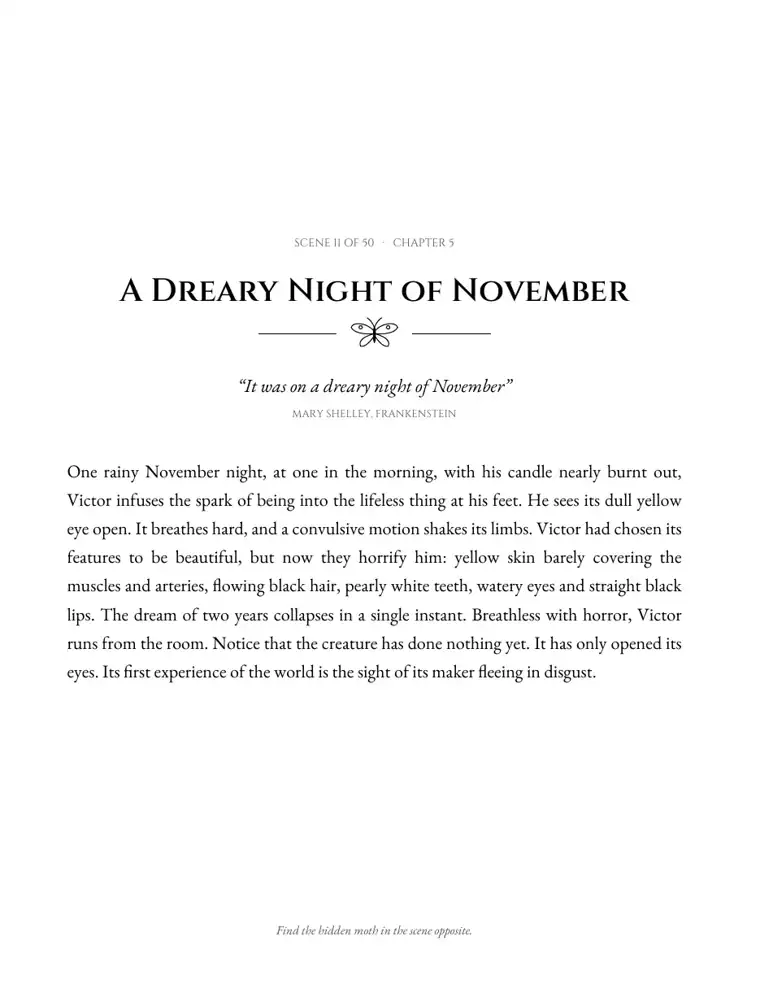
Every illustration has a facing text page with:
- The scene number (1 to 50) and the chapter or letter it comes from
- A title, such as "A Dreary Night of November" or "The Sea of Ice"
- A quotation from Mary Shelley's novel
- A short summary of what is happening at that point in the story
Read it before you pick up a pencil. It takes a minute or two, and it changes how you see the drawing. A storm over a lake is a pretty picture; a storm over a lake on the night Victor returns to Geneva after his brother's death is a scene.
Step 2: Color in story order — or don't
The scenes run in the same order as the novel, so working front to back lets you follow the plot as a continuous reread: Walton's letters, Victor's childhood, Ingolstadt, the creation, the creature's own narrative, the bargain on the mountain, the final pursuit.
But nothing breaks if you jump around. Some readers like to start with the scenes they remember best (the laboratory, the glacier). Others save the Arctic for winter. The summaries make every spread self-contained, so you can always find your place in the story.
A few practical notes
- Paper and tools. The book is a standard 8.5 × 11 in paperback. Colored pencils and fine-tip markers suit the detailed linework. If you use alcohol markers or anything wet, slip a spare sheet behind the page to protect the next one.
- Detail level. The scenes are dense — architecture, foliage, ice, fabric. Fine points help in the small areas; broad strokes work for skies.
- Test page. There is a color test page at the front. Use it before committing to a palette.
Ready to start with Scene 1?
Step 3: Find the moth
Moth & Quill Press is named for a moth drawn toward the light — which is also, more or less, the plot of Frankenstein. So a small moth is hidden in every one of the 50 scenes (and in the prologue too).
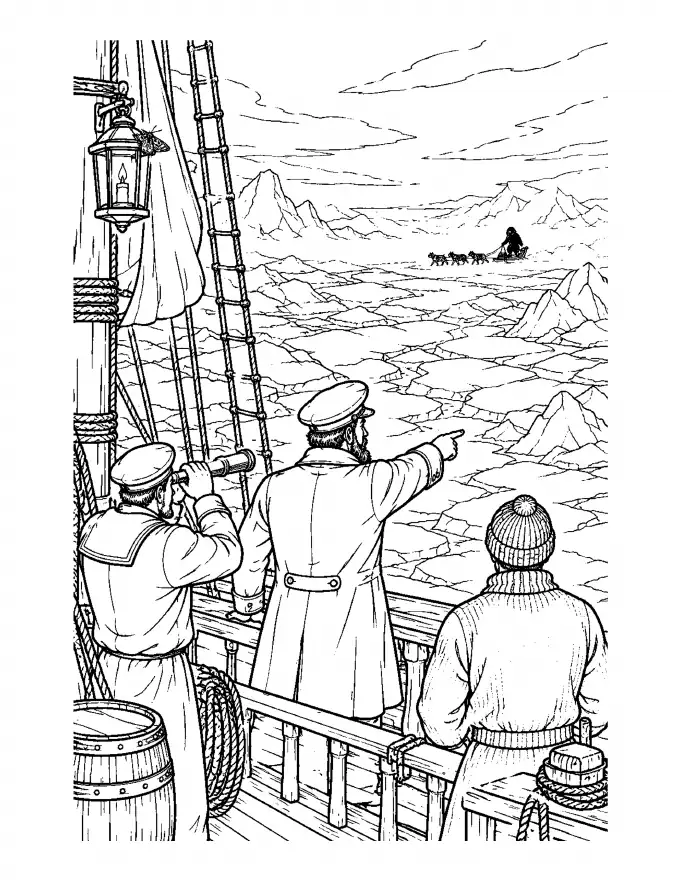
It is never in the same kind of place twice. It might be resting on a lantern, tucked into carved woodwork, half-lost among leaves, or sitting on a windowsill while the storm goes on outside. Finding it rewards slow looking — the same slow looking that good coloring asks for anyway.
A suggestion: search for the moth before you color the scene. Once you have found it, decide whether to make it stand out — a single warm note in a cold page — or let it disappear again.
Step 4: Let the palette follow the story
Because the scenes follow the novel, you can let your colors follow it too:
- Geneva and childhood: warmer greens and golds, open skies
- Ingolstadt and the laboratory: narrower, darker, candle-lit
- The creature's forest and the De Lacey cottage: seasonal — from winter grey to spring green
- The Alps and the glacier: cold blues, white, granite grey
- The Arctic ending: ice, darkness, and perhaps a thin line of northern light
By the last page, the book itself becomes a record of the story's emotional temperature.
What this book is — and isn't
It is a coloring and reading book made for entertainment and enjoyment: a way to spend unhurried time with a great novel. It is not a therapeutic, medical or wellness product, and we don't present it as one.
Frequently asked questions
Do I need to have read Frankenstein first?
No. The facing summaries tell the story in order, so you can follow the whole plot through the book. Readers who know the novel will recognise each scene.
How many pages are there to color?
There are 50 illustrated story scenes, plus a bonus prologue illustration about the 1816 origin of the novel.
What should I color with?
Colored pencils and fine-tip markers work well for the detailed linework. If you use wet media, place a protective sheet behind the page.
Is there really a moth in every picture?
Yes. A small moth is hidden in every scene, a nod to the Moth & Quill Press name.
Keep reading
Frankenstein: A Gothic Coloring Journey Through Mary Shelley's Classic — 50 scenes, facing summaries and quotes, a hidden moth in every page. Paperback, $12.00.
See the book and order your copy
Available on Amazon from the book page. A coloring and reading book for entertainment and enjoyment — not a therapeutic or wellness product.